Electronics problems are some of the most frustrating, because they come and go. The guitar works at home and cuts out at the gig. A knob gets scratchy halfway through a song. Most of these have simple causes. Here's how to narrow them down, plus the wiring mistakes behind most failed DIY pickup swaps.
What's wrong with my guitar's electronics? (Quick chart)
| Symptom | Most likely cause | First thing to try |
|---|---|---|
| Signal cuts in and out | Cable, or output jack | Try another cable; wiggle the plug |
| Scratchy or crackling knob | Dirty pot | Electronics contact cleaner |
| Loud hum that's worse when you touch the strings | Ground or wiring fault | Have the wiring checked |
| One pickup position is silent | Broken pickup lead or bad switch | Tap-test each pickup |
| Thin, hollow sound with two pickups on | Pickups out of phase | Check the wiring diagram and pickup colors |
| Nothing at all | Cable, jack, or a broken ground or hot wire | New cable, then check the jack |
Why does my guitar keep cutting out?
Start with the cheapest fix: try a different cable. Cables fail far more often than guitars do. If the problem stays, plug in and gently wiggle the plug in the guitar's jack. If the sound cuts in and out, the output jack is the culprit. There are three usual reasons:
- The jack's nut has loosened. The jack spins, and the wires twist until they break.
- The jack's spring contact has lost tension and doesn't grip the plug.
- A solder joint on the jack has cracked.
Why is my volume or tone knob scratchy?
Dust and oxidation build up on the track inside the potentiometer, or "pot." A small spray of electronics contact cleaner into the pot opening, then turning the knob back and forth 20 or 30 times, fixes most scratchy pots. Don't use WD-40 or general-purpose oil.
If the pot is still noisy, feels gritty, or has a dead spot, it's worn out and should be replaced.
Why does my guitar hum or buzz through the amp?
- Single-coil pickups hum by design. It's louder near computer screens, dimmers and fluorescent lights. Turning to face a different direction changes it.
- Hum that drops when you touch the strings is normal. Your body is helping ground the guitar.
- Hum that gets louder when you touch the strings, or hum that appeared suddenly, usually means a ground wire is broken or something was wired wrong.
- Shielding the control cavity with conductive paint or copper tape can reduce noise, but only if it's connected to ground properly.
Is my pickup dead, or is it the wiring?
Pickups rarely die on their own. A broken lead wire or a bad solder joint is much more common. To check:
- Plug in, select the pickup, and tap its pole pieces lightly with a small screwdriver. A working pickup makes a clear tapping sound.
- If it's silent, check that pickup's wires at the switch for a broken or loose connection.
- With a multimeter across the pickup's leads, you should see a resistance reading, often in the thousands of ohms. No reading at all, with no continuity, means the coil or lead is broken.
What are the most common DIY wiring mistakes?
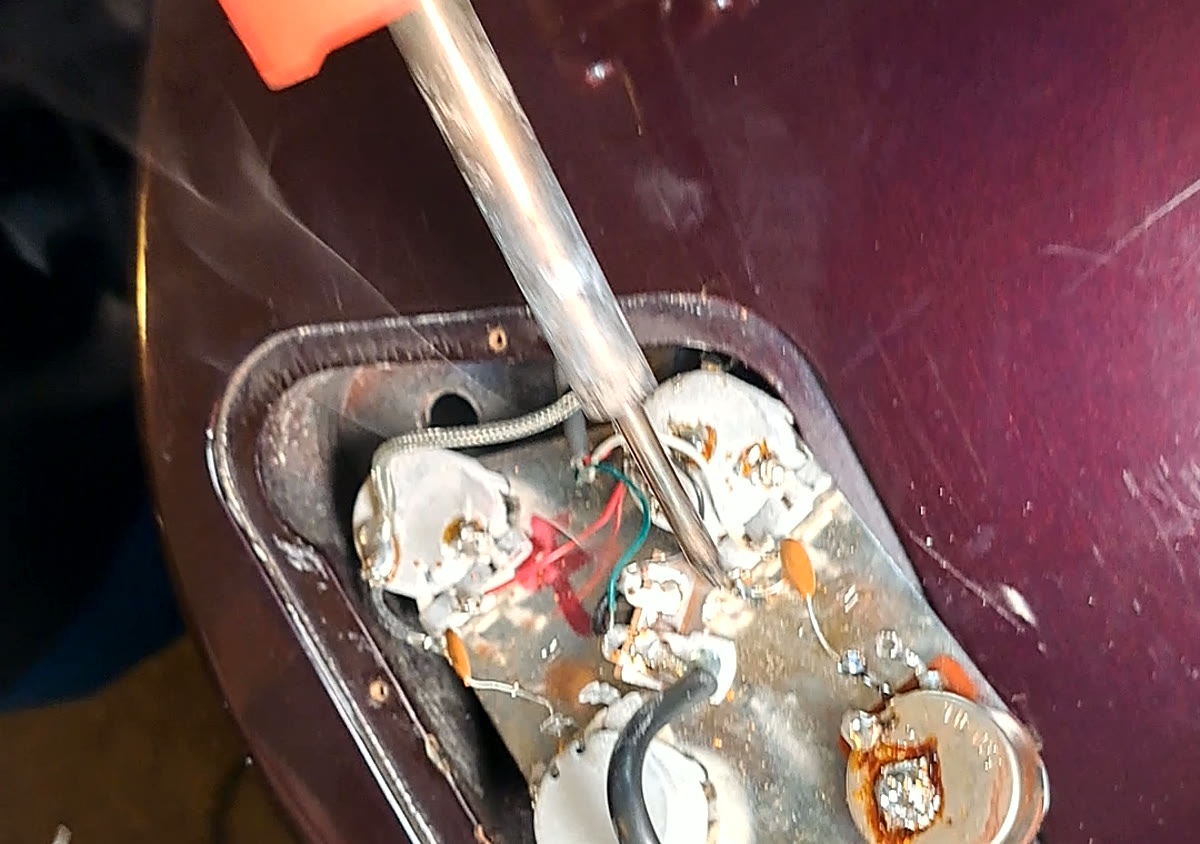
Cold solder joints
A good joint is shiny, smooth and flows around the wire. A cold joint is dull, grainy or balled up. It often works at first and then fails. The cause is usually not heating the parts enough, or moving the wire before the solder sets.
Overheating pots, switches and pickup leads
Holding a hot iron on a part too long can damage pots and switches, and melt the insulation on thin pickup wires. Tin the wire and the lug first, then make the joint quickly.
Using the wrong solder
Use rosin-core electronics solder. Acid-core solder is made for plumbing and corrodes electronics over time.
Pickups wired out of phase
Pickup makers use different wire color codes. If you follow the wrong diagram, two pickups on together can sound thin, quiet and hollow, because one is cancelling the other.
Missing or broken grounds
The bridge, pots, jack and switch all need to connect to ground. A missed ground wire is a common reason for loud hum after a DIY rewire.
Pinched wires
Wires pinched under a pickguard or control plate can short out or break later. Route them neatly and check before you screw everything down.
When should you let a shop do the wiring?
Pickup swaps on simple guitars are a reasonable first soldering project if you practice on scrap wire first. Here's when it's worth handing it over:
- Complex switching: coil splits, series/parallel or push-pull pots.
- Active electronics.
- Vintage guitars, where original solder joints affect value.
- Any time a DIY job has left the guitar noisier than it started.
At Six String Revival, general electronics repair is $30, a single pickup install is $55, a full set is $75, a partial rewire starts at $80 and a full rewire starts at $150. See more DIY repairs that go wrong.
Frequently asked questions
Why does my guitar cut out?
The most common cause is a bad cable, so test with a different one first. Next is the output jack: if wiggling the plug makes the sound cut in and out, the jack is loose, worn or has a broken wire. Less often it's a broken solder joint or a worn pickup selector switch.
How do I fix a scratchy volume knob?
A scratchy or crackling pot is usually dirty. Spraying a small amount of electronics contact cleaner into the pot and rotating it back and forth often fixes it. If it's still noisy afterward, or the knob feels loose or gritty, the pot is worn and should be replaced. General electronics repair is $30 at Six String Revival.
Why does my guitar hum?
Single-coil pickups naturally hum near lights, screens and power supplies. Hum that gets quieter when you touch the strings is normal grounding. Hum that gets louder when you touch the strings or metal parts, or that suddenly appeared, points to a wiring or ground problem.
How do I know if my pickup is dead?
Tap the pickup with a small screwdriver while plugged in. If you hear nothing, check the wiring first, since a broken lead is more common than a dead pickup. A multimeter across the pickup leads should show a resistance reading, often several thousand ohms; an open reading with no continuity means the coil or lead is broken.
How much does it cost to rewire a guitar?
At Six String Revival a single pickup installation is $55, a full pickup set is $75, general electronics repair is $30, a partial rewire starts at $80, and a full rewire starts at $150 including pickup installation.